
The matrix can be used to assess your employee's skill and willingness to do a specific task. Based on that assessment, you can choose how to best manage the employee towards success.
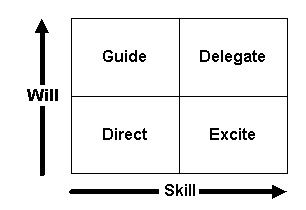
An employee is rarely in one quadrant all the time. An employee will
fall into one quadrant or another depending on the task and their
Skill: Experience with the task, training, knowledge, and natural
talents.
Will: Desire or achieve, incentives to do task, security
surrounding job, confidence in abilities, and feelings about task
("attitude")
Guide
Be clear regarding expected outcomes (goals) and limitations of
time, budget, etc.
Discuss and set methods.
Check for understanding
Identify and provide required training.
Accept early mistakes as important "coaching" moments.
Give responsibility and authority for the pieces of tasks
employee can do.
Structure tasks to minimize possible risks to employee and company
Provide frequent feedback.
Require frequent check-ins (verbal or written) early in the project,
but relax control as progress is shown
Praise and reward for success
Delegate
Be clear regarding expected outcomes (goals) and limitations of
time, budget, etc.
Involve in decision-making
Frequently ask employee for opinions
Check for understanding
Give responsibility and authority because employee is competent
and committed.
Provide feedback.
Ask for check-ins at key milestones or when employee has
questions.
Praise and reward for success
Direct
Discuss what would motivate employee. Agree on what is
possible.
Be clear regarding expected outcomes (goals) and limitations of
time, budget, etc.
Set clear rules, methods, and deadlines
Check for understanding
Give responsibility and authority for the pieces of tasks
employee can do.
Structure tasks for quick wins
Identify and provide required training.
Provide frequent feedback.
Require frequent check-ins (verbal or written) early in the project,
but relax control as progress is shown.
Praise and reward for success
Excite
Discuss why task is important and why employee is best choice.
Discuss what would motivate employee. Agree on what is
possible.
Be clear regarding expected outcomes (goals) and limitations of
time, budget, etc.
Check for understanding
Give responsibility and authority because employee is competent
Provide frequent feedback.
Require frequent check-ins (verbal or written)
Praise and reward for success
Source: The Skill / Will Matrix is an adaptation of Keilty,
Goldsmith and Co. Inc. of
Original work by Hershey and Blanchard